
Dog Park Etiquette & Safety in Greater Victoria
By Anna Hakim & Perry Fanthorpe, Happy Homes Team at eXp Realty
Dog park etiquette at a glance:
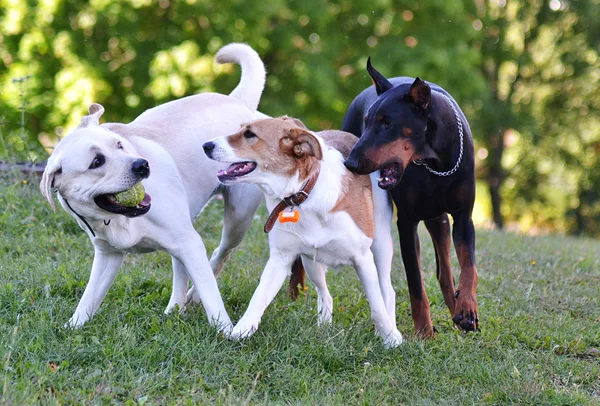
The local dog park is a great place to play with your four-legged friend and enjoy the outdoors together. It is also a chance for your pup to connect with other dogs and socialize, and maybe to meet other dog-lovers in the community. In theory, everyone gets along at the dog park. In practice, manners can easily be forgotten, and some pet guardians simply are not aware of proper dog park etiquette.
Well-socialized dogs and their guardians help make dog parks enjoyable for everyone. Here is what to keep in mind the next time you visit, drawing on tips from trainers accredited by the BC SPCA's AnimalKind program.
A note from the Chief Canines
Ziggy and Sahara don't go to dog parks themselves. Their humans prefer to manage their exercise and socialization differently. But we know lots of Greater Victoria dog owners rely on dog parks for off-leash time and socializing, so here is how to make those visits as safe and enjoyable as possible. If a fenced dog park does not suit your dog, there are plenty of off-leash alternatives around Greater Victoria, from leash-optional beaches to open trails.
Make sure your dog is prepared to meet other dogs
Before you expose your dog to what could be a swarm of unknown dogs, it helps to have trained and established some protocols first. Bernadette van Klaveren at DAWG Training Academy points out that the ideal greeting is dogs approaching calmly and taking a polite sniff of each other's hindquarters. That calm, respectful exchange is the goal, not excited rushing.
The reason behind the sniffing matters too. Dogs recognize people and dogs by scent far more than by sight. Let them take that moment to gather information, and it sets a much calmer tone for whatever comes next.
Do not be afraid to interrupt play sessions
The foundation skill that can save your dog a lot of grief is the ability to interrupt play between two or more dogs, says van Klaveren. This is not a formal recall, more like an intermission, often with treats for all parties, followed by continuing the play. It is a pause, not an ending.
A good rule of thumb is to interrupt every 15 seconds to two minutes of continuous play. Repeating this makes de-escalation easier over time, because your dog learns that a pause is expected and no big deal. If your dog is good at self-interrupting, meaning it pauses to sniff, lie down, turn away, or check in with you, you can be less vigilant, but it still helps to do this with every new dog-to-dog encounter.
Watch small-versus-big dog interactions
Kelsey Patterson at Authentic Canine Training urges guardians to watch interactions between big and small dogs, especially chase games. A chase can spill from harmless fun into what trainers call predatory drift, where the small dog suddenly turns from playmate to prey in the big dog's eyes. That shift can happen fast.
If the park has separate big and small dog areas, use the appropriate side. It is one of the simplest ways to keep a mismatched mismatch from turning into a problem.
Be mindful of toys and games
Fetch with a ball or a frisbee can be great exercise, but if other dogs are around, check in with their guardians before you throw. Another dog may be ball crazy, may race for the toy, or there could be resource guarding in play. A quick check-in prevents a lot of drama.
Leave possessive toys at home, saved for the backyard or an empty space where there is no competition. If you do play ball, consider bringing at least four items to toss, so there is one for every dog and far less reason for conflict.
It is okay if your dog outgrows the park
For many dogs, the park is great dog-to-dog time from about six to eight months of age, says Sharon Labossiere of Hanging with Hounds. It is completely normal for many dogs to outgrow it around the three to four year mark, preferring instead to do a circuit of the park and then head for the gate, or simply sniff the perimeter.
That is not a failure on your part or a sign that something is wrong. It is just your dog's preference showing up. Arrange play dates with a close doggy friend instead, and everyone stays happier.
More etiquette every guardian should keep in mind
- Watch your dog at all times. Set boundaries, intervene with clear commands when your dog misbehaves, and praise positive behaviour. Be ready to recall your dog at the first signs of trouble, such as bared teeth, low growls, or offensive posturing.
- Ask before offering treats. It is polite to ask before offering any treat to someone else's dog, because dogs can have allergies or medical conditions such as pancreatitis, and an unexpected treat can make them ill. If you do bring treats for your own dog, keep them tucked out of sight: other dogs will smell them and may start pestering you and your dog for them.
- Practise consent tests. If one dog is pursuing and the other is running away, ask the other owner to hold their dog so the pursued dog can choose whether it actually wants to continue.
- Bring extra poop bags and always pick up after your dog. It is the simplest way to keep the park clean and welcoming for everyone.
- Spay or neuter your dog. Spayed or neutered dogs are less likely to incite or exhibit aggression. Low-cost spay and neuter options are available in British Columbia through the BC SPCA.
Important correction from the Happy Homes Team
Do not take your dog's collar off at the park. Most municipal bylaws require your dog to wear its licence tag at all times, so the collar stays on. Taking off a harness is completely fine; the collar stays. This matters for safety and for staying on the right side of local rules.
If you are ever unsure, a good trainer makes all the difference
When in doubt, check out trainers recommended by the BC SPCA at animalkind.ca/find-services and find a kind, knowledgeable trainer to foster a positive relationship with your dog. A little support goes a long way toward turning park visits into the relaxed, fun outings they should be.
If a fenced yard and walkable park access are on your list, let us help you find a neighbourhood where both actually line up. See our dog-friendly neighbourhood guides or book a time to talk about your move.
Looking for off-leash options beyond the fenced park? Check out our guides to leash-optional beaches and off-leash trails around Greater Victoria, or start with the region-wide off-leash parks guide.
Sources and further reading
- "Proper Etiquette at the Dog Park," by Ellen Lindell, VMD, DACVB; Monique Feyrecilde, BA, LVT, VTS (Behavior); and Lynn Buzhardt, DVM, published by VCA Canada. Read it at vcacanada.com/know-your-pet/proper-etiquette-at-the-dog-park.
- BC SPCA AnimalKind accredited trainers. Find a kind, knowledgeable trainer at animalkind.ca/find-services.