
How Do I Help My Dog Settle Into a New Home in Victoria, BC? Moving Stress Tips for Dogs
By Anna Hakim & Perry Fanthorpe, Happy Homes Team at eXp Realty
Helping Your Dog Settle Into a New Home in Victoria, BC:
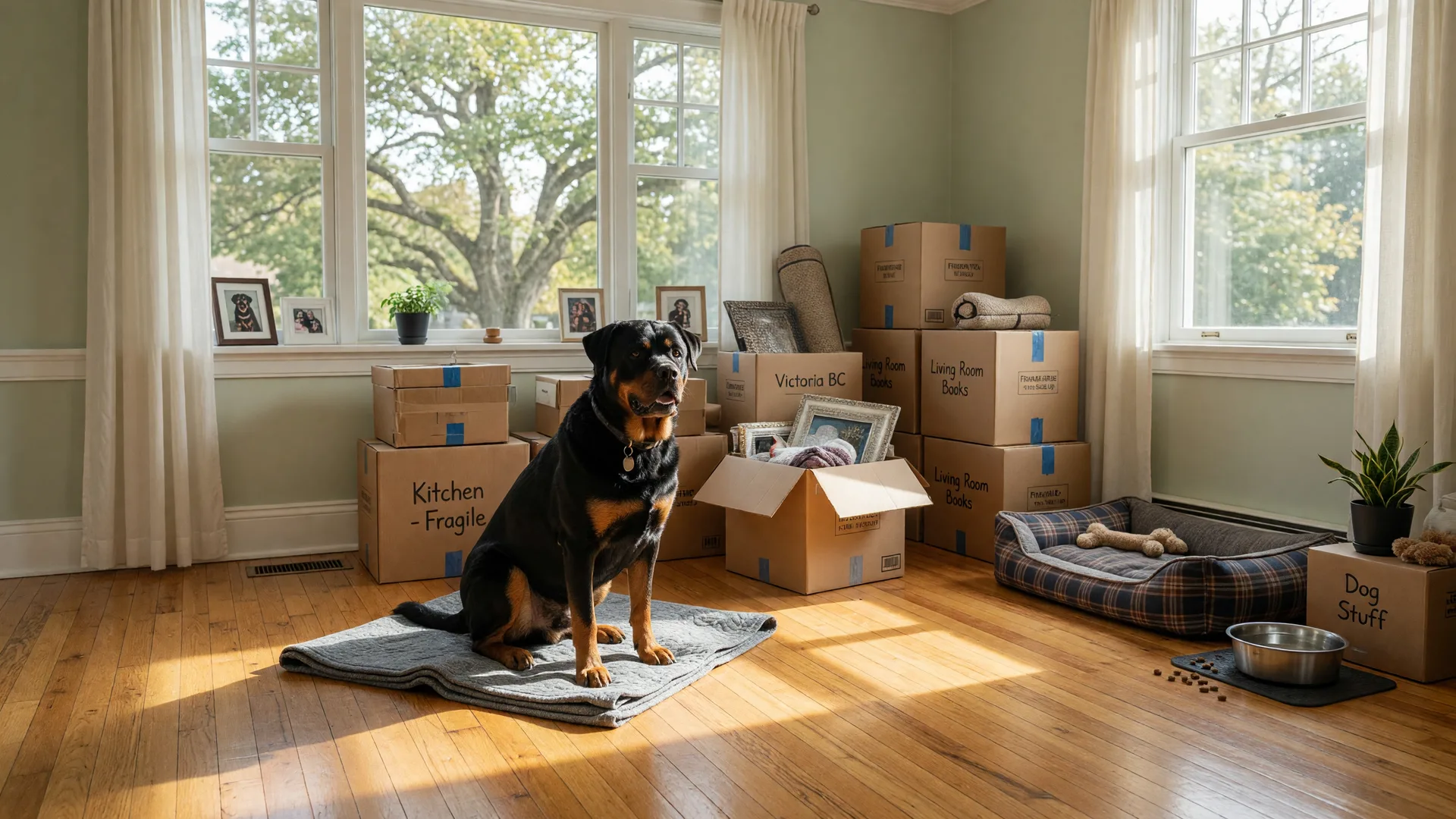
Moving to a new home is stressful for dogs in ways that are different from how humans experience it. Your dog does not understand why their familiar house, their usual walking route, and the neighbour dog who sniffs through the fence have all disappeared. They only know that everything smells different and nothing is where it used to be. I have helped dozens of clients move into new Victoria homes with their dogs, and I have moved my own dogs twice. The difference between a stressful transition and a smooth one comes down to preparation and patience.
Here is exactly what works for helping a dog settle into a new home in Victoria, based on what I have learned from our own moves and from years of helping clients make the transition with their dogs.
How do I prepare my dog for moving day?
The most important thing you can do is keep your dog away from the chaos. Moving day itself is loud, confusing, and full of strangers walking through the house carrying furniture. The best plan is to have your dog stay with a friend, family member, or trusted pet sitter during the actual move. If that is not possible, set up one quiet room in the old house with your dog's bed, water, and a frozen Kong, and keep the door closed while movers work.
In the days before the move, pack your dog's things last. Their bed, bowls, favourite toys, and a blanket that smells like you should be the last items packed and the first items unpacked at the new house. The familiar scent is more comforting than any new dog bed you could buy.
If your dog is anxious in cars, do a few short practice drives before moving day. A stressed dog + a long drive to a new house + a car that smells unfamiliar = a recipe for carsickness and anxiety. For dogs moving to Victoria from elsewhere in BC, the BC Ferries sailing from Tsawwassen to Swartz Bay can add an extra layer of stress. Check our guide to taking your dog on BC Ferries for tips on the sailing.
What should I do in the first 24 hours at the new house?
Bring your dog into the new home after the movers have left and the furniture is in place. The quieter the environment, the easier the transition. Start by setting up their bed, crate, bowls, and toys in one room and let them explore that room first. Keep the water bowl in the same spot it was in the old house if you can, or as close as possible.
Take your dog for a walk around the new neighbourhood within the first few hours. Let them sniff, mark, and explore at their own pace. This is not a training walk, it is a reconnaissance mission. Your dog is building a mental map of where the new front door is, where the nearest patch of grass lives, and which way leads to the interesting smells. I have seen dogs settle noticeably faster when their owner walks them within the first hour of arrival versus waiting until the next morning.
Keep the first meal at the new house simple. Serve their regular food in their regular bowl at the regular time. Do not introduce new treats or new food brands on moving day. Sahara gets an upset stomach from stress, and I have learned the hard way that moving day is not the time to experiment with a new brand of kibble.
How long does it take for a dog to adjust to a new home?
Every dog is different, but the general timeline is consistent across most breeds and ages. The first three days are the hardest. Your dog may refuse food, pace at night, or follow you from room to room. This is normal. By the end of the first week, most dogs start eating normally and sleeping through the night. After two to four weeks, you will see your dog's personality return fully: the tail wags at the door, the excitement before walks, the usual spot on the couch.
Senior dogs and rescue dogs can take longer. Sahara was about 10 when we moved last, and it took her a full three months to settle in completely. She ate, slept, and walked normally by week two, but the relaxed, fully comfortable body language took months. Be patient and do not rush the process.
Signs that your dog is settling include eating their full meal without hesitation, sleeping in their usual position (not in a tight ball), playing with toys on their own, and initiating walks rather than needing to be pulled out the door. If your dog is not showing these signs after four weeks, consider talking to your vet or a Victoria-based dog trainer who can help with transition anxiety.
Should I keep the same routine after moving?
Yes, as much as humanly possible. Feed at the same times, walk at the same times, and use the same commands and cues you always have. The routine is the anchor your dog holds onto when everything else has changed. If your old walk started at 7:30 AM, start the new walk at 7:30 AM. If dinner was at 5:00 PM, dinner is at 5:00 PM at the new house too.
The one thing that will inevitably change is the walking route itself. That is fine, but introduce the new routes gradually. Stick to one or two routes for the first week before expanding. Too many new smells and new streets in one day can overwhelm a dog that is already working through the stress of the move.
How do I find a new vet in Victoria before moving?
Find a vet clinic in your new neighbourhood before you need one. Moving is stressful enough without scrambling to find an emergency vet at 10 PM on a Tuesday. Transfer your dog's medical records to the new clinic at least a week before the move if you can, or as soon as you have the new address.
Walk to the new vet clinic with your dog on a non-emergency visit. Go during business hours, let the receptionist give your dog a treat, and leave. No exam, no needles, just a positive visit. This makes a huge difference if your dog ever needs to go back in a hurry. Our guide to choosing a vet in Victoria covers the clinics worth considering.
What about microchip and licence updates?
Update your dog's microchip registration with your new Victoria address and phone number as soon as you have possession of the new home. Most microchip registries let you do this online in under five minutes. If your dog gets lost in the first few days after a move (the most common time for dogs to bolt from an unfamiliar property), an outdated microchip record makes it much harder to get them home. Our lost dog guide for Greater Victoria covers the full action plan.
Your dog's CRD dog licence also needs to be updated with your new address. If you are moving between municipalities in Greater Victoria (from Victoria to Saanich, for example), you may need a new licence from the new municipality. Check our complete guide to dog licensing and bylaws for the rules in each area. Fines for unlicensed dogs range from $100 to $150 depending on the municipality, so do not skip this step.
How do I introduce my dog to the new yard or balcony?
If your new home has a yard, check the fence line before you let your dog out unsupervised. Look for gaps at the bottom, loose boards, or areas where a determined dog could dig their way out. Victoria has a lot of wooden fences that look solid from a distance but have gaps at the base that a medium-sized dog can squeeze through.
For the first week, go out into the yard with your dog on a long line rather than letting them loose. This lets them explore safely while you assess whether the fence is actually secure. After a week of supervised yard time, you will know whether your dog tries to patrol the perimeter or stays close to the door.
If you are moving to a condo with a balcony, do not assume your dog will understand the concept of a balcony railing. Keep balcony time supervised, especially with breeds that like to lean on railings or jump at passing birds. A harness clipped to a short tether gives your dog freedom to enjoy the balcony without the risk of going over the edge.
What if my dog struggles with the new neighbourhood sounds?
Victoria neighbourhoods have different sound profiles. A house on a quiet Saanich cul-de-sac sounds nothing like a condo near downtown where emergency sirens and garbage trucks run past every morning. Some dogs adjust quickly. Others need time to habituate to the new noise landscape.
If your dog is struggling, use white noise or a fan in the room where they sleep to mask unfamiliar sounds. Play calm music during the day when you are out. Walk during quieter hours (early morning or late evening) for the first week before gradually introducing busier times. This is the same approach we use for fireworks and noise anxiety, and it works for the same reason: gradual desensitisation beats flooding every time.
How yard size and fence quality affect your home search
I have walked through a lot of Victoria homes with dog owners, and the number one thing people overlook is the yard access. A beautiful backyard with a fence that has a six-inch gap at the bottom is not a functional dog yard. A condo with a balcony and no elevator is a problem for a senior dog who struggles with stairs. These are the details we catch before our clients make an offer.
When you start looking for a home that works for your dog, think about the settling process before you move in. Is the fence secure? Is there a quiet room where your dog can decompress on day one? Is the nearest park close enough for a morning walk that does not require a car? These details matter more than the square footage of the kitchen. The Happy Homes Team helps dog owners find homes that work from day one. Book a coffee chat and let us know what you and your dog need.