
How Do I Keep My Dog Calm During a Windstorm in Victoria?
By Anna Hakim & Perry Fanthorpe, Happy Homes Team at eXp Realty
The Short Answer:
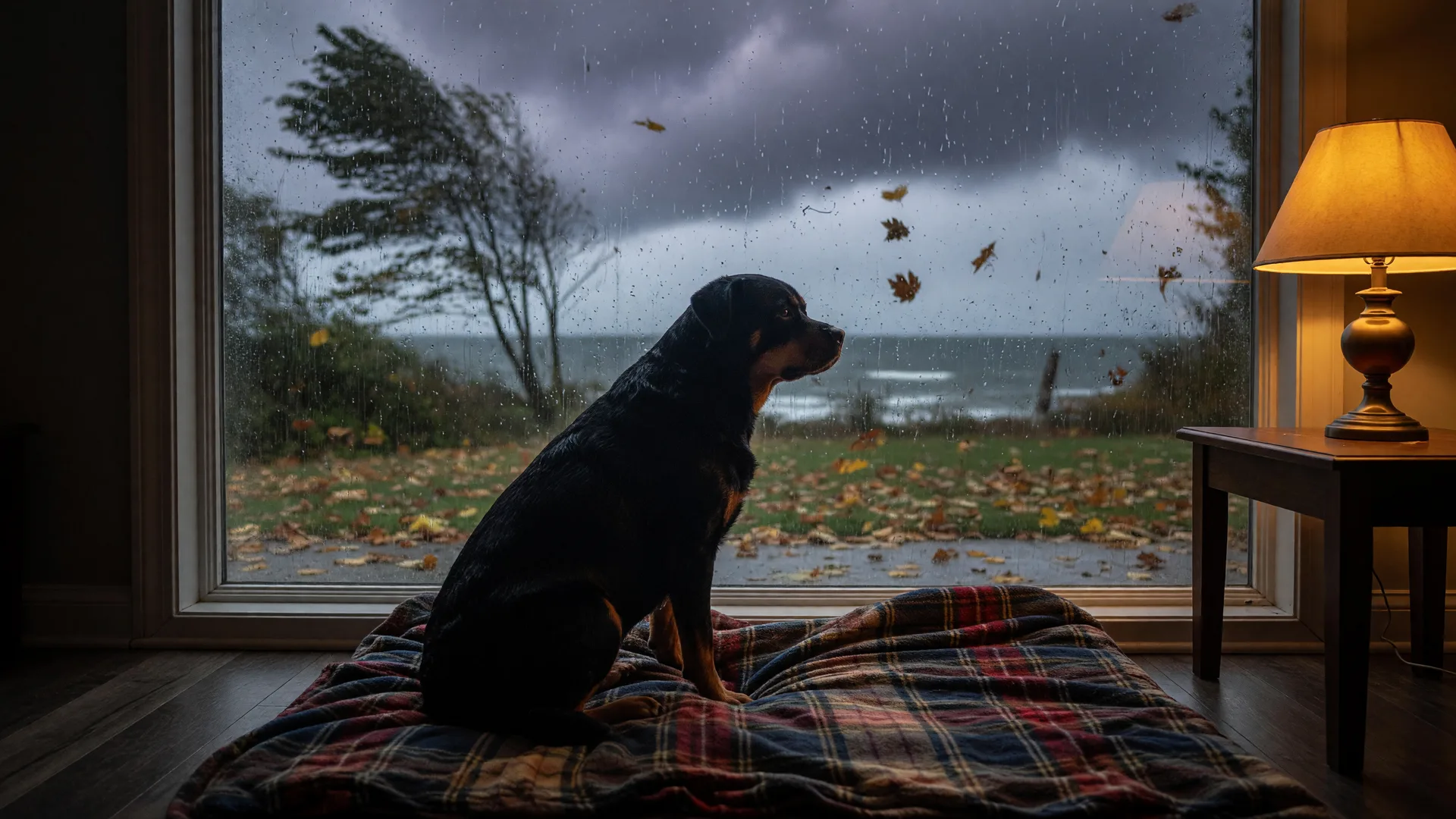
Windstorms are part of the deal when you live in Greater Victoria, and so is a dog that paces and whines when the gusts pick up. You cannot stop the wind, but you can stop it from being the loudest thing in your dog's world: set up a quiet den in the calmest room of your home, mask the noise, keep your routine boring, and be ready for the power to go out, because the outage is usually the bigger stressor than the storm itself. Here is how we get through the big ones with Ziggy and Sahara.
November is the month we check the sky and the outage map before we check anything else. We have sat through the worst of it with two very different dogs, one who needs a plan and one who sleeps through anything, and the same routine has worked for both.
How bad do Victoria windstorms actually get?
Environment Canada puts out a wind warning for Greater Victoria when it expects sustained winds around 60 to 65 km/h inland, or gusts to 90 km/h. The exposed spots along Haro Strait, the Strait of Juan de Fuca and the Malahat catch the worst of it, and every few years a proper storm rolls through that we all remember.
The storm on November 9 and 10, 2021 knocked out power for roughly 8,500 BC Hydro customers on Vancouver Island, about 4,000 of them on the South Island, including Colwood, Langford and the Saanich Peninsula. A few years later, in November 2024, a bomb cyclone with gusts near 160 km/h on the south coast left more than 100,000 BC Hydro customers on Vancouver Island in the dark. These are not rare events, they are the weather we live in, and dog owners should plan like it.
Why does my dog react to the wind?
Part of it is the noise: the howling, the banging of a loose gate, branches scraping the window. Part of it is that your dog reads your energy, and on wind-warning days most of us are checking the sky, refreshing the outage map and bracing for something. A dog that is already on edge picks that up fast.
Some dogs also react to the drop in barometric pressure that comes with a deep low. That part is worth knowing, because it means the anxiety can start before the first branch hits the roof, not after. If your dog starts pacing while the day is still calm, the storm is probably already on its way in its body.
What should I set up before the storm hits?
Pick the calmest room in your home and make it your dog's storm base. For most people that is the bedroom or a bathroom, the space farthest from the rattling windows and the tapping branches. If you use a crate, this is where it should live, with the door open and a blanket over the top, so it reads as a cave rather than a cage.
Before the wind arrives, take the edge off. A long walk or a solid fetch session means the dog is tired when the storm starts, and a tired dog cares a lot less about the weather. Then set up the distractions: a food puzzle, a frozen Kong, a chew. Close the curtains, because it is hard to explain to a dog that the branches moving outside are fine, so take the view away.
Do not wait for the storm to start to practice the routine. If the crate and the bedroom are part of your normal day, they are part of the routine on a windy night too, and routine is the single most calming thing you can give a nervous dog. Our guide to keeping a dog busy on rainy days has more of the indoor tools that carry you through a storm afternoon.
What do I do while the wind is howling?
Keep your voice low and your movements normal. You do not need to comfort a storm-anxious dog with a big fuss, and you should not be cross with it either. Behave like the wind is an ordinary Tuesday, because that is the message your dog is actually reading.
Play white noise or put on the radio to cover the gusts. Background sound smooths out the sudden bangs, which are the parts that spike a dog's fear. Keep a light on if you can, and if your dog chooses the bathtub or under the bed, let it. Being allowed to choose its own safe spot is part of the calm.
How do I handle a power outage with my dog?
Outages are where the real planning lives, because losing power for a night or two changes everything about keeping a dog comfortable. The classic Victoria outage runs longer than you expect, so think in 72 hours, not in one night.
BC Hydro's own guidance for a 72-hour emergency kit includes the dog: food, water for at least 72 hours, dishes, a blanket and any medications. Keep that kit somewhere you can grab it in the dark, not buried in a cupboard. And use LED lanterns or flashlights, not candles. BC Hydro warns about this for a reason, and it is a real one: a candle at dog-tail height is one excited wag away from a house fire.
If the power goes out, check the BC Hydro outage map and report your outage if it is not listed. Keep the dog on a leash or in the crate before letting it outside in the dark, because a startled dog in a pitch-black yard is how dogs slip gates. And if you have a generator, run it outdoors and well away from windows and doors. The exhaust is deadly to people and dogs alike, and it is quiet enough that neither of you will know until it is too late.
If you see a downed power line, stay at least 10 metres back and call 911. That is not a dog-walking moment, that is a turn around and go home moment.
When should I call the vet about storm anxiety?
If your dog genuinely panics, paces for hours, trembles uncontrollably, or has tried to escape through a window or door, that is beyond a routine handling problem and it is worth a conversation with your vet. There are safe, veterinary-directed options for storm-phobic dogs, but they need to be set up ahead of time and prescribed for your specific dog, not borrowed from a friend's routine. For more on the noise side of this, our noise anxiety survival guide covers the same ground from a different trigger.
Ziggy does not love the wind, but he settles if we follow the routine. Sahara, at 13, mostly sleeps through it now. The dogs are not all the same, and neither are the houses, which is where the next part comes in.
The home side of storm season
How well your home rides out a windstorm is mostly a question of the building itself: an interior room or basement to retreat to, heating that works without hydro, a fence and gate that hold under a gust, and windows that do not rattle half the neighbourhood. When we show homes to dog owners, those are the features we quietly check, because they are the difference between a stressful night and an ordinary one. Our earthquake prep guide covers the same idea for a different disaster, the grab-and-go plan that works for both.
Short, dark days are part of the same season, and a house with a good layout matters less than a dog that got its run. If the wind keeps you off the beach, the lit off-leash parks guide is the winter workaround we use all the time.
If you are thinking about a move and want a home that handles a Victoria winter better for your dog, book a consultation with the Happy Homes Team and tell us what your current storm nights look like. We have walked through enough windstorm mornings to know exactly what to look for.
A Home That Rides Out the Storm Better
A good dog home has a calm interior room, a fence that holds, and heating that works without hydro. The Happy Homes Team knows which properties in Victoria, Saanich, and the Westshore actually deliver that.
Book a Consultation