
Wildlife Encounters on Trails: Deer, Cougars & Raccoons: Keeping Your Dog Safe in Greater Victoria
By Anna Hakim & Perry Fanthorpe, Happy Homes Team, eXp Realty | AI Certified Agents
Wildlife Encounters for Dogs in Greater Victoria:
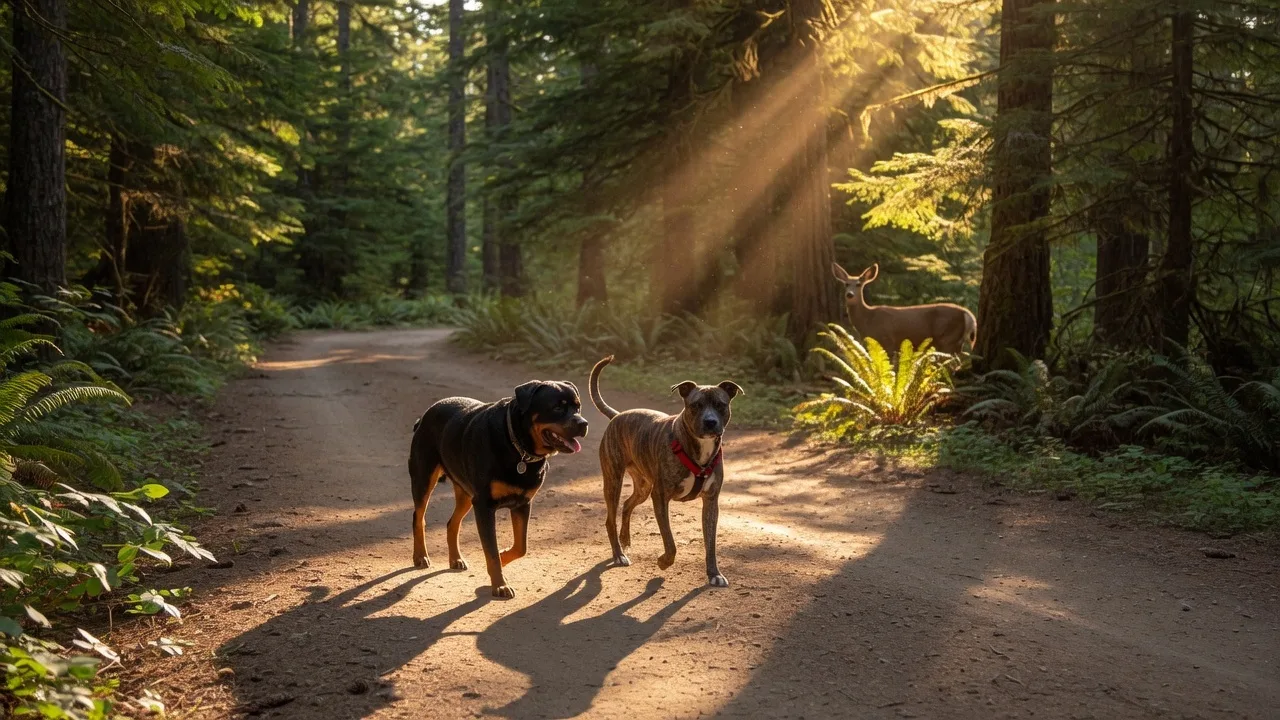
We did not think much about wildlife encounters until the morning Ziggy locked onto a deer on the Galloping Goose near Uptown and nearly pulled Perry off his feet. Our 100-pound Rottweiler does not have a mean bone in his body, but the prey drive that kicks in when a deer bounds across the trail is something else entirely. That morning taught us what every Greater Victoria dog owner eventually learns: you share these trails with a lot more than just runners and cyclists, and knowing how to handle wildlife encounters is as essential as carrying poop bags.
Greater Victoria sits inside one of the most biodiverse regions of Canada. The Capital Region is the birding capital of the country with over 400 species recorded, and the urban deer population here is among the densest in the country. Cougars roam the green spaces of Saanich regularly enough that police have issued public warnings. Black bears, raccoons, and birds of prey all call these trails home. Your dog does not understand that the deer on the trail is not a playmate or that the cougar in the treeline is a predator. That is your job. Here is what we have learned about keeping dogs safe on Victoria's wildlife-rich trails.
Deer: The Most Common Wildlife Encounter You Will Have
If you walk your dog on any Victoria trail with any regularity, you will encounter deer. Oak Bay, the Uplands, Mount Douglas Park, the Galloping Goose through Saanich, and the trails around PKOLS (Mount Doug) all have dense deer populations. Most of the time the deer will see you first and move away. But during fawning season, roughly May through July, the calculation changes completely.
A doe with a fawn hidden nearby will not run. She will stand her ground, and if your dog gets too close, she may charge and strike with her front hooves. In late May of this year, the BC Conservation Officer Service specifically warned Victoria residents about aggressive deer encounters after a string of incidents. Dogs have been injured. Small dogs are especially vulnerable because a doe will target whatever she perceives as the threat, and a leashed dog cannot get away.
Here is what we do on trails during fawning season:
- Keep your dog leashed. This is not optional on trails with deer. An off-leash dog chasing a deer stresses the animal, risks injury to the dog from hooves, and can get the dog lost deep in the woods.
- Scan ahead constantly. We play a game called "spot the deer first." If you see the deer before your dog does, you can change direction, create distance, or get your dog into a sit-stay before the prey drive kicks in.
- Give deer at least 30 metres of space. If the trail passes closer than that, step off the trail and wait, or turn around and find another route. Do not try to squeeze past a deer with a hidden fawn.
- Know the high-risk areas. Mount Douglas Park trail network, the Uplands, Cedar Hill Golf Course edges, and the Galloping Goose through Saanich are all deer-dense zones. Adjust your route in late spring and early summer.
If a deer charges your dog, do not try to get between them. Make yourself loud, wave your arms, and step toward the deer while keeping your dog behind you. A deer that charges is usually trying to drive the threat away, not fight to the death. Back off slowly once the deer has made her point.
Cougars on Vancouver Island: The Real Predator Risk
Vancouver Island has one of the highest cougar densities in North America, and these animals do not stay in the backcountry. Cougar sightings in Saanich, Metchosin, and East Sooke are regular enough that local news covers them as a recurring seasonal story. In 2025, a string of daytime cougar attacks on dogs in the East Sooke and Metchosin areas prompted warnings from the BC Conservation Officer Service, and Saanich police issued renewed public warnings after multiple cougar sightings within 48 hours.
The key thing to understand about cougars is that they are ambush predators. They hunt at dawn and dusk, they target animals that are alone or separated from their human, and they are most active during the same hours most of us walk our dogs before and after work.
What to Do in a Cougar Encounter
- Do not run. Running triggers a chase response in a cougar the same way it does in a dog. Stand your ground.
- Make yourself large and loud. Open your jacket, raise your arms, speak in a loud firm voice. You want to look and sound like something the cougar does not want to tangle with.
- Pick up small dogs immediately. A small dog in a cougar's eyes is prey, not a companion animal. Lift your dog without bending over if you can, keep yourself between the cougar and the dog.
- For larger dogs, keep them close and behind you. A Rottweiler-sized dog standing next to you may deter a cougar, but keep the dog on a short leash and positioned at your side or behind you.
- Back away slowly. Keep facing the cougar and move backward without turning your back. Give the animal a clear escape route.
- Carry bear spray. On remote trails and in known cougar areas, bear spray on your belt is a reasonable precaution. Know how to use it before you need it.
Realistically, most of us will never have a cougar encounter despite walking trails daily. But the ones who do and are prepared walk away. The ones who are not prepared sometimes do not, at least not with their dog. A leash, awareness of your surroundings, and knowing the drill make all the difference.
Raccoons: Closer to Home Than You Think
Raccoons are everywhere in Greater Victoria, and they are not timid. They raid garbage bins in every neighbourhood, they den under decks and in sheds, and they are active at the same times many of us do last-call walks with our dogs. A raccoon encounter in a park or on a trail is usually a non-event. Both parties see each other and go their separate ways. But a cornered raccoon, or a raccoon protecting its young, will fight.
Raccoons carry diseases that can be dangerous to dogs, including canine distemper and raccoon roundworm. A bite or scratch from a raccoon requires a vet visit, not just a wipe with antiseptic. The risks are real enough that we have changed our own walking habits: we avoid trails that run close to known raccoon denning areas after dark, and we keep Ziggy and Sahara on a short leash near any garbage bins or dense underbrush at night.
If your dog corners a raccoon, call your dog off immediately. Do not try to separate them with your hands. Use a stick, a water bottle, or your leash to create distance. A raccoon bite is not something you want your dog to experience, and a raccoon that feels trapped can do real damage to a dog's face and legs.
Birds of Prey: A Risk for Small Dogs
This one is rare but worth knowing about. Bald eagles, red-tailed hawks, and great horned owls all live in Greater Victoria. These birds hunt small mammals, and a dog under 20 pounds fits that description. Attacks on dogs are uncommon, but local community reports confirm that eagles and owls can and occasionally do target small pets, particularly near active nests during breeding season.
If you walk a small dog, be aware of large nests in the canopy above trails, especially on the Galloping Goose through Saanich, around Mount Douglas, and along the Colquitz River trail. Keep small dogs close and consider a brightly coloured vest or jacket that makes them look larger and less prey-like. The same advice applies to off-leash areas near treelines where owls perch: dusk is prime hunting time, and a small dog running free looks an awful lot like dinner to a hungry owl.
Bears: Not Just for the Backcountry
Black bears live throughout Vancouver Island, and they occasionally wander into Greater Victoria's suburban green spaces. In 2025, a surge in bear and cougar conflicts was reported by local news, with bears accessing unsecured garbage in residential areas. A dog that encounters a bear off-leash may trigger a defensive response that neither the dog nor the human is prepared for.
On trails where bears are known to be active, keep your dog leashed, make noise as you walk (talking, a bear bell, even just the jingle of your dog's tags), and carry bear spray. If you see a bear, do not let your dog approach, and back away slowly the same way you would with a cougar.
Birds on the Trail: A Different Kind of Risk
The Capital Region is Canada's birding capital with over 400 species recorded, and some of those birds nest in the same parks and trails we walk our dogs through. Panama Flats in Saanich and the Colquitz Trail are notable hotspots where off-leash dogs have been flagged as a threat to migratory and ground-nesting birds. Conservation groups have specifically raised concerns about dogs disturbing bird populations in these areas.
This matters because a dog that flushes a ground-nesting bird might find themselves on the wrong end of an angry parent bird. Gulls, crows, and ravens will dive-bomb dogs that get too close to nests, and a determined crow can draw blood on a dog's back and head. More importantly, it is our responsibility as dog owners to share these trails in a way that does not harm the wildlife that calls them home. If you see posted signs about nesting areas, respect them. Keep your dog on the trail and out of the tall grass along the edges.
A Seasonal Wildlife Calendar for Greater Victoria
Wildlife Risk Calendar
- Late spring (May-June). Peak fawning season. Highest risk of aggressive doe encounters. Fawns are hidden in tall grass and underbrush close to trails. Keep dogs leashed.
- Early summer (June-July). Birds nesting in tall grass at Panama Flats, Colquitz Trail, and Cuthbert Holmes Park. Cougar sightings increase as young cougars disperse.
- Late summer (August-September). Berries ripen, drawing bears into lower elevations and closer to trails. Raccoons and other wildlife are highly active. Deer are less aggressive but still present on all trails.
- Year-round. Cougar risk exists in all seasons, with peak activity at dawn and dusk. Raccoon encounters are most common after dark in urban parks and neighbourhoods. Eagle and owl nesting territories are active year-round.
What We Carry on Every Trail Walk
We have adjusted our trail kit based on actual encounters, not hypotheticals. Here is what comes with us on every walk where wildlife might be present:
- A short leash (6 feet or less). Retractable leashes and wildlife encounters do not mix. When we are in deer or cougar territory, the dogs are on a fixed-length leash, period.
- A whistle or air horn. Loud noise stops most wildlife encounters before they escalate. A sharp blast on a whistle has sent deer moving away from us on the trail.
- High-value treats. Something stinky and irresistible that breaks your dog's focus on wildlife. Freeze-dried liver, cheese sticks, anything that outranks the deer in your dog's priorities.
- A headlamp. For dusk walks, so we can see eyes reflecting off the trail ahead before our dogs do.
The Bottom Line
Wildlife encounters on Greater Victoria trails are a matter of when, for almost every dog owner. Most of them are harmless: a deer bounds away, a raccoon ambles into the bushes, a crow squawks from a branch and your dog barely notices. The encounters that turn into emergencies are the ones where the human was not paying attention, the dog was off-leash, or nobody knew what to do when the animal did not back down.
The formula is simple: keep your dog leashed on trails where wildlife is present, scan the trail ahead constantly, know the seasonal risks for the area you are walking in, and carry the tools to break your dog's focus if the prey drive kicks in. That is how you share these beautiful trails with the wildlife that belongs here, without either one getting hurt.
We have been walking these trails with Ziggy and Sahara for years, and we have never had a bad wildlife encounter. Not because we are lucky. Because we are prepared. You can be too.
Stay safe out there, Victoria.
🐾