
How Do I Protect My Dog's Paws in a Victoria Winter?
By Anna Hakim & Perry Fanthorpe, Happy Homes Team at eXp Realty
The Short Answer:
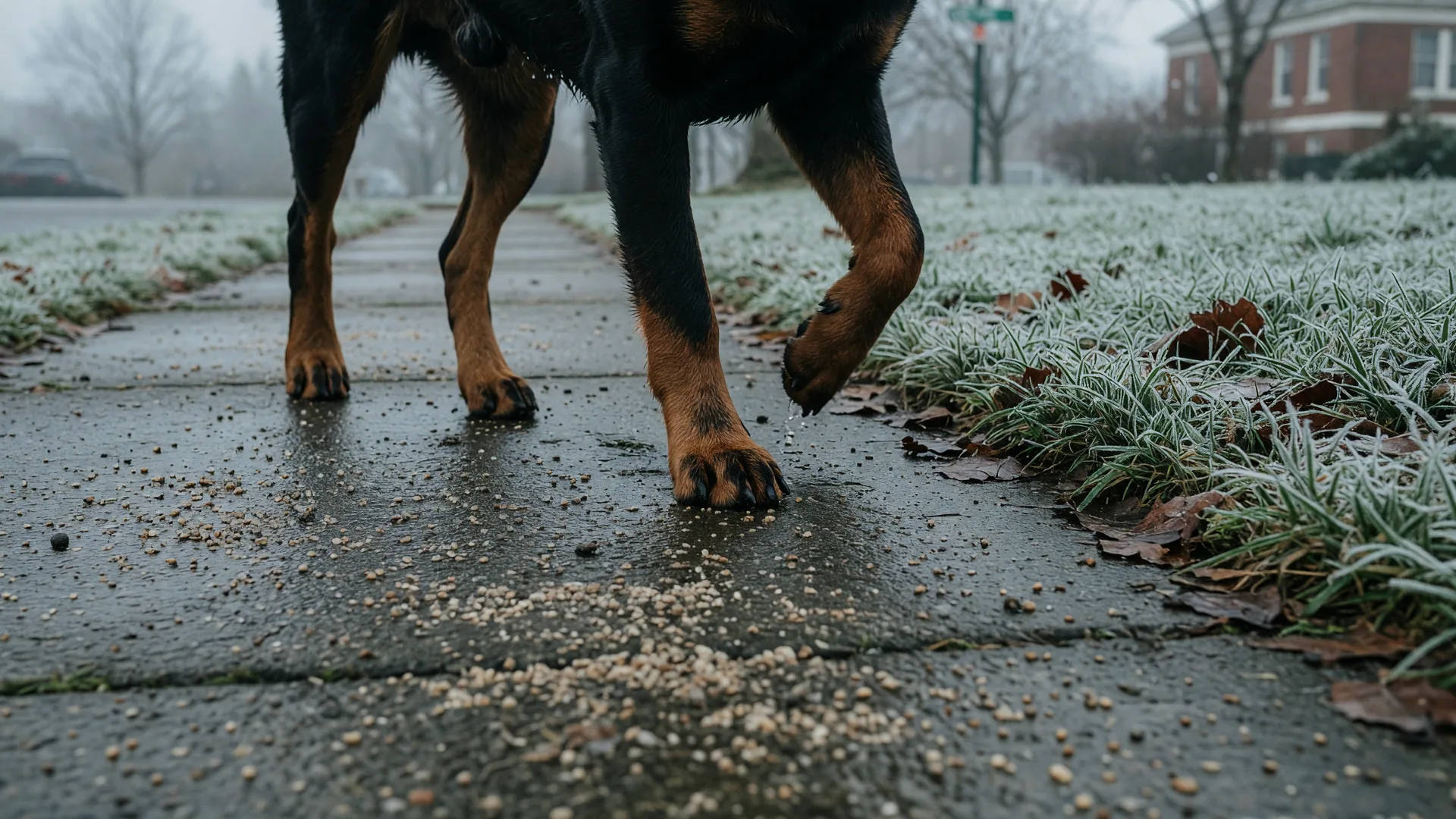
In a Victoria winter, the ice is not the biggest threat to your dog's paws, the salt and brine underneath it are. Most winters here are wet more than they are frozen, but when the cold snaps do hit, roads get pre-treated with salt brine and sidewalks get salted, and all of that ends up under your dog's feet. A routine of paw wax or boots, plus a quick rinse after every walk, keeps most dogs comfortable right through the season.
We live this one with a senior dog and a busy Rottweiler, so the two of them need different setups. Sahara's pads are older and crack faster, while Ziggy will happily run through anything until his feet hurt, at which point he stops mid-walk and stares at me like it is my fault. This guide is the system we have landed on after several Victoria winters with both of them.
What actually hurts dog paws in a Victoria winter?
The de-icers are the main culprit. Rock salt (sodium chloride), calcium chloride, potassium chloride, and magnesium chloride all do the same thing to paws: they draw moisture out of the pad, leaving it dried out, cracked, and irritated, and the gritty crystals can lodge between toes and rub raw spots. Some products also end up as residue on the pads, and a dog that licks it off can end up with an upset stomach.
There is one ingredient to watch for especially. Ethylene glycol, the same chemical as antifreeze, shows up in some ice melts and is highly toxic to dogs, so check the label of anything you buy for your own walkway before it goes down.
The freezing itself is a smaller factor in Victoria, because true hard frosts are rare here compared with the interior. When ice and snow do arrive, ice balls can pack between the toes and under the nails, and the sand and gravel spread on roads adds its own grit. None of it is a reason to skip the walk, it is a reason to plan the walk.
What exactly does the city put on the roads and sidewalks?
The City of Victoria runs a Severe Weather Response Plan that pre-treats priority routes, emergency routes, hospitals, fire and police access, major arterials, hills, and bridge decks, with an anti-icing salt brine before a cold snap, then salts and plows as snow accumulates. Under the Streets and Traffic Bylaw, residents and businesses must clear snow and ice from the sidewalk fronting their property by 10 a.m. after a snowfall, which is why the de-icer concentration is highest near homes and shops.
Saanich runs a similar program, pre-treating with brine and salt on priority roads, and its own guidance for residents is to reach for sand, high-nitrate fertilizer, or calcium chloride instead of corrosive products. Practically, that means the worst surface for paws is a residential sidewalk that got salted heavily after an overnight freeze, followed by intersections, bus stops, and curb ramps where slush and brine pool.
Does my dog need boots in Victoria, or is paw balm enough?
For most Victoria dogs, most of the season, paw balm is enough. The city does not salt everyday residential streets the way prairie cities do, so a barrier wax before the walk handles the average wet, cool day. Boots become worth it on the worst days: after a fresh brine application, on hard-packed ice, on heavily salted commercial sidewalks downtown, or whenever your dog has thin or sensitive pads.
Boots only work if they fit. Too loose and they spin and chafe, too tight and they cut circulation, so take your dog to a shop and actually try them on. Sahara wears boots on the coldest mornings because her pads crack in a way Ziggy's never have. Ziggy refuses boots entirely, so he gets a generous layer of wax and shorter streets, and honestly his feet are better off than mine are.
How do I care for my dog's paws after a walk?
The single best habit is a rinse and dry after every walk. Warm water, not hot, washes the salt and grit off the pads, and a thorough dry between the toes keeps moisture from softening and cracking the skin. Check the paws while you dry: look for ice balls, lodged grit, redness, or a pad starting to split.
Trimming the fur between the toes in winter helps too, because long fur grabs ice balls and holds wet against the skin. A quick trim every few weeks makes a real difference for dogs with feathering between their toes. We keep a towel by the front door and a boot tray under it, and the rinse happens before anybody sets foot on the hardwood.
What should I use on my own walkway at home?
Your own front walk and gate are the one patch of ground you control, so skip the chloride products there entirely. Plain sand works, kitty litter works, and urea-based pet-safe melts are a solid middle ground. Avoid anything with ethylene glycol in the ingredients, and remember that salt residue from your yard gets tracked back inside by the exact same paws you are trying to protect.
If you have a paved driveway or a long walkway, a covered or heated entry point makes the whole routine easier in January. That sounds like a housing conversation, and it is one. We will get to it.
Where can I buy paw balm and boots in Victoria?
Paws On Cook at 200 Cook Street in Cook Street Village carries paw balms and a range of boots, and the staff actually explain sizing instead of pointing at a rack. The Bone & Biscuit at Uptown Shopping Centre stocks the same kind of gear. For the Westshore, Bosley's covers it, and James Bay Pet Supplies at 300 Beckley Avenue and For Pet's Sake in Victoria West are both good neighbourhood options.
Buying in person matters for boots. Your dog has to wear these, so get the fit right the first time rather than guessing at sizes online.
Why winter paw care changes where you should live with a dog
The winter routine is a daily test of your setup: is there a dry place to rinse paws near the door, a gate that keeps the dog off a freshly brine-treated street, a walkable loop to a nearby trail that does not require crossing four salted intersections? These are the small details that never appear in a listing photo but shape every morning from November to February.
When we show homes to dog owners, we check the entry and the yard first. A covered mudroom entry, a fenced yard with a gate that opens onto a quieter street, and a sidewalk you can reach the Galloping Goose or a neighbourhood trail from without a car ride, all of it matters more than the paint. If you are thinking about a move with your dog in mind, book a consultation with the Happy Homes Team and we will walk through which areas make winter mornings easier.
A Home That Makes Winter Walks Easier
A covered entry, a fenced yard, a quiet street that leads to a trail, all of it matters more in January than in July. The Happy Homes Team helps dog owners find that setup in every price range across Greater Victoria.
Book a Consultation