
Is It Safe for My Dog to Drink From Puddles on Winter Walks in Victoria?
By Anna Hakim & Perry Fanthorpe, Happy Homes Team at eXp Realty
The Short Answer:
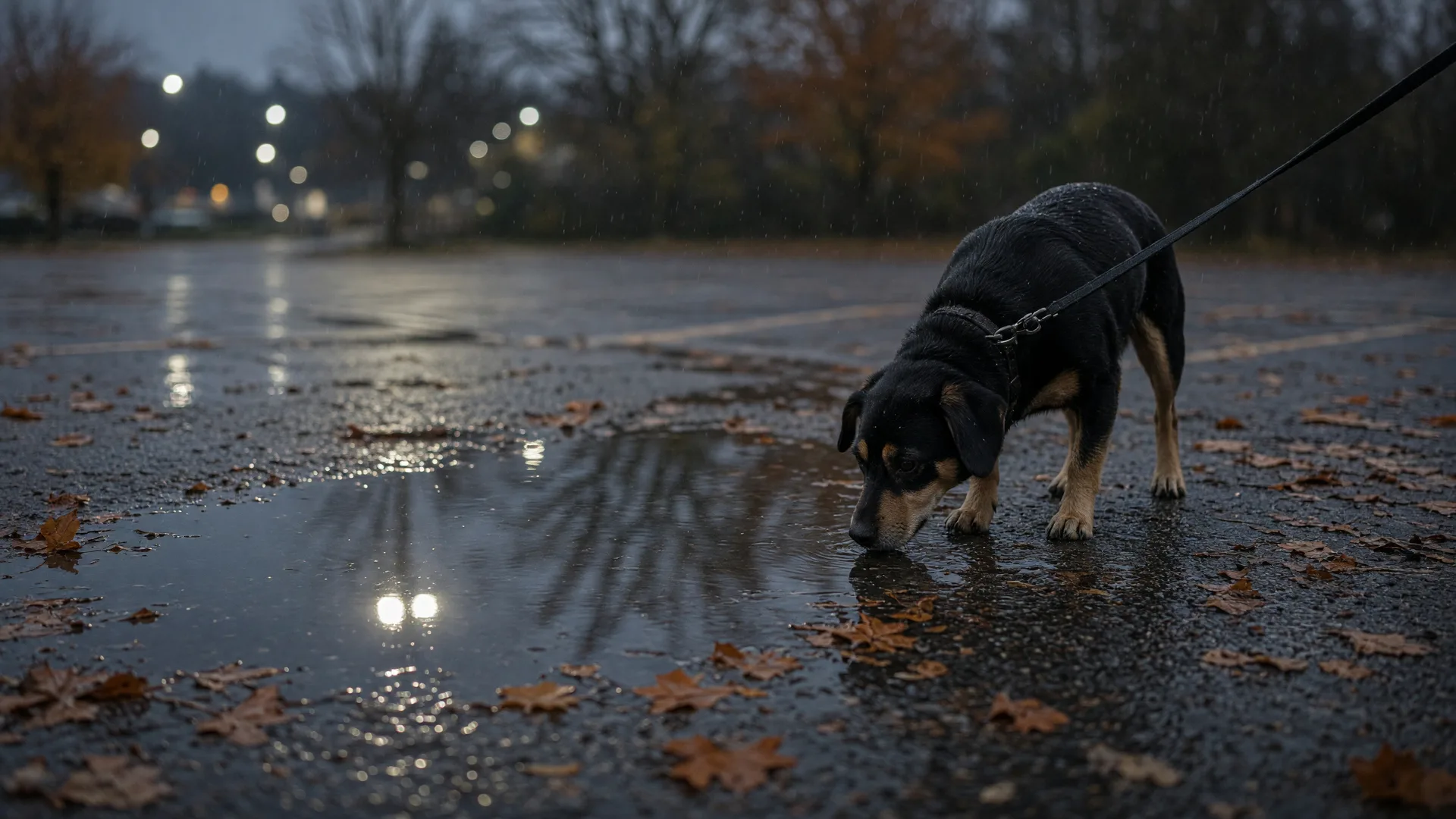
No, do not let your dog drink from puddles on Victoria streets, driveways, or parking lots in winter. Rain and meltwater collect de-icer residue, road salt, oil, and the occasional antifreeze leak in every low spot, and ethylene glycol antifreeze tastes sweet to a dog and can be fatal in less than a tablespoon. The fix is free: carry water and let your dog drink from your hand, a bottle, or a collapsible bowl.
This is one of those rules that sounds paranoid until you watch a dog head for a parking lot puddle with intent. We have both said the word no more times than we can count, which is why the carry-water habit is a permanent part of our walk kit, rain or shine.
Why are winter puddles riskier than summer ones?
In summer a puddle is mostly rain, and rain alone rarely makes a dog sick. In winter the same puddle is a collection tray. The City of Victoria pre-treats priority roads with salt brine and salts after snow, so curbs hold de-icer residue, while driveways and parking spots collect the oil and coolant that cars drip year round and especially during cold snaps.
Cold weather is when coolant systems actually leak. Hoses and gaskets shrink and crack in the cold, which is why those sweet-smelling antifreeze puddles show up under parked cars in November far more often than in July.
How much antifreeze is dangerous for a dog?
A very small amount. A tablespoon can be fatal to a dog, and the lethal dose works out to roughly 6.6 mL per kilogram of body weight, so a 30-pound dog is in danger after about 90 mL, less than half a cup. The worst part is the taste: ethylene glycol is sweet, so most dogs do not just stumble into it, they drink it on purpose.
Some ice melts and heat-transfer fluids contain the same chemical. That is why the ingredient label on your own driveway products matters too, and why our winter paw care guide tells you to avoid anything with ethylene glycol in the mix on your own walkway.
What are the signs of antifreeze poisoning in dogs?
The symptoms come in three stages, and the middle one is the trap. In the first 30 minutes to 12 hours the dog looks drunk: staggering, vomiting, drinking and peeing more than usual, and acting tired. Then, between 12 and 24 hours, the dog can appear to recover completely, which is a false recovery while the real damage is setting in. Acute kidney failure follows at roughly 36 to 72 hours, with renewed vomiting, seizures, and collapse.
That false recovery is why you never wait for symptoms. If you even suspect antifreeze, act on the suspicion, not on how good the dog looks.
What should I do if my dog drinks antifreeze?
Treat it as an emergency and move fast. Call Central Victoria Veterinary Hospital or WAVES, the two 24-hour emergency options in Greater Victoria, or the Pet Poison Helpline at 855-764-7661, and tell them the timing and roughly how much was consumed. Do not make the dog vomit unless a vet tells you to, because some products can do more damage coming back up.
The antidote, ethanol or fomepizole, works best when it starts within 8 to 12 hours of ingestion, and time is the entire game. Grab the antifreeze container too, if one is within reach, because the label tells the vet exactly what they are fighting.
What about plain road salt and de-icer in puddles?
Salt is a separate, milder problem. De-icers like rock salt and calcium chloride dry and crack paw pads, lodge between toes, and give a dog that licks the residue an upset stomach, which is unpleasant but not an emergency. The routine that handles it is a rinse and dry after every walk, and our winter paw care guide covers the full drill, including which de-icers to avoid entirely.
How do I stop my dog from drinking puddles on walks?
Teach a clear leave it, watch for the head drop, and manage the environment: keep dogs out of pooled water near parked cars, driveways, and storm drains, and let them drink from the bowl you carry. A thirsty dog finds puddles, so offer water before the walk and at the halfway mark, and they will have far less reason to go exploring.
On trails and in off-leash areas the rule is simpler: skip standing water entirely. Park puddles are not much safer than street puddles, because stagnant water carries the same bacteria and parasite risks as anywhere else, just with fewer cars and more geese.
What do winter puddles have to do with where you live?
The walk route is a housing feature, and it is one we actually look at during showings. A home a block off a busy arterial means the daily walk crosses parking aprons, gas station driveways, and curbs where brine pools, while a house near a trail system can give a dog its whole walk without touching a single puddle. When we show homes to dog owners, we walk the route the dog will walk, because the first-intersection problem decides every morning from November to February.
If you are thinking about a move and you want a place where the dog's daily walk starts and ends on safe ground, that is a very specific kind of house hunt, and it is ours. Book a consultation with the Happy Homes Team and we will walk the routes with you before you decide.
Choose the Home Where the Daily Walk Is Safe by Default
The daily route matters as much as the floor plan: trail access, crossing count, and how close the parking lots are. The Happy Homes Team matches homes to dogs, not just buyers to listings.
Book a Consultation