
7 Victoria Beaches Declared Unfit for Swimming in 2026: What Dog Owners Need to Know
By Happy Homes Team at eXp Realty, Victoria, BC
- ▶ 7 beaches flagged across Greater Victoria: Thetis Lake, Prior Lake, and Beaver Lake (blue-green algae), Gonzales Bay, Esquimalt Gorge Kinsmen, and Ross Bay (elevated enterococci bacteria), and Art Mann Park (unsatisfactory bacteriological results since 2015).
- ▶ Blue-green algae toxins can kill dogs. They cause LIVER DAMAGE that can be lethal, and can be present even when no visible algae is seen. Dogs are especially vulnerable because they drink the water while swimming.
- ▶ Enterococci bacteria are highly antibiotic-resistant and can cause serious infections in the bloodstream, urinary tract, and surgical wounds.
- ▶ Keep your dog on a leash at any beach with an active advisory. Warning signs are posted at all impacted locations by Island Health. Do not let your dog drink or swim in affected waters.
- ▶ Before heading out: Check the CRD beach water quality monitoring page and carry fresh water for your dog.
- ▶ Safe alternatives: Ocean beaches unaffected by freshwater bacteria and algae advisories, including Parker Park and other saltwater spots.
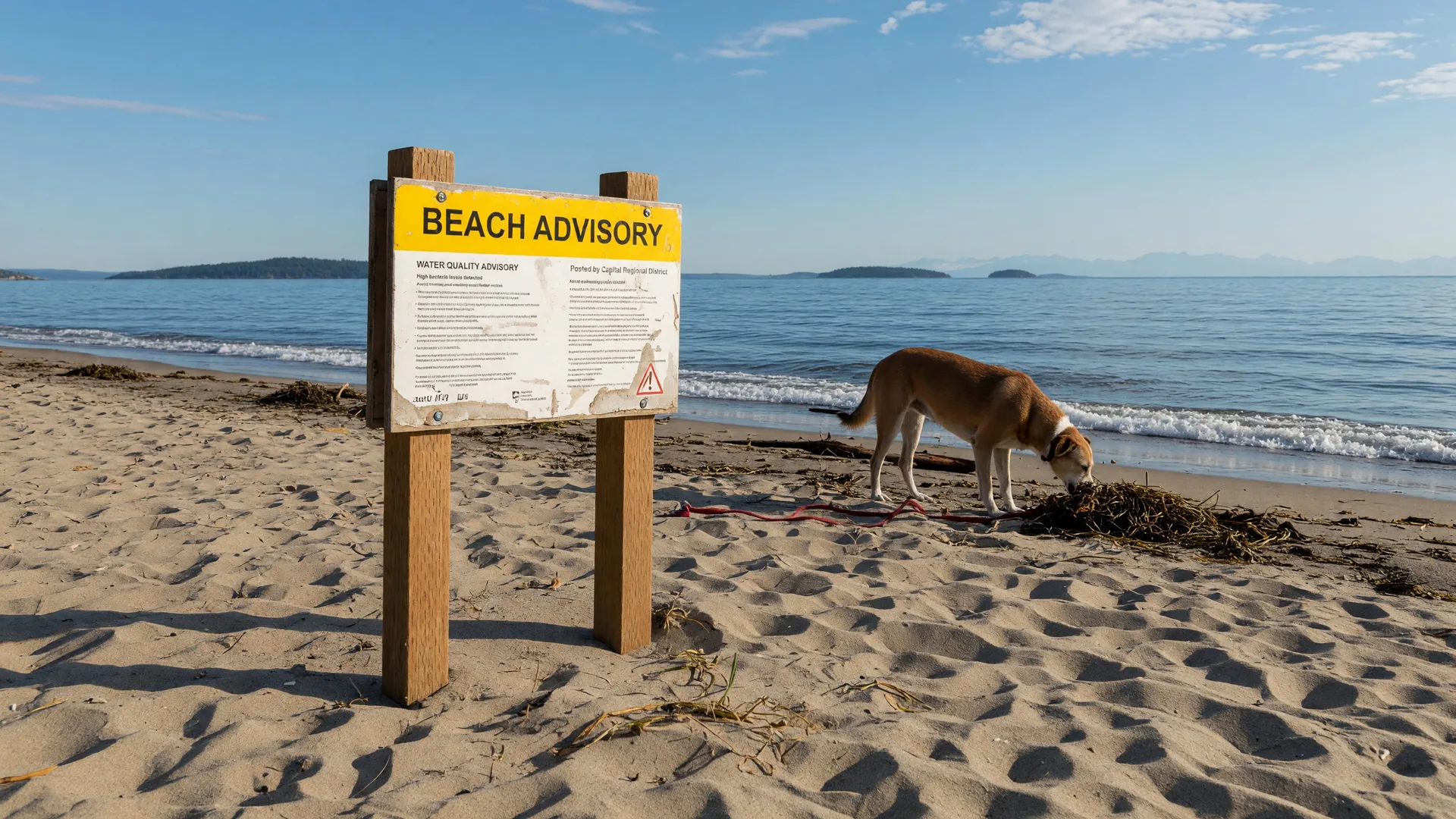
As of mid-July 2026, seven beaches in Greater Victoria have been declared unfit for swimming by Island Health through the Capital Regional District's beach water quality monitoring program. According to Island Health advisories reported by Victoria Buzz, three of them were flagged for blue-green algae (cyanobacteria) blooms, three for elevated levels of enterococci bacteria, and one for unsatisfactory long-term bacteriological results. For dog owners, this news matters more than it does for the average beachgoer. Here is why, and what you need to know to keep your dog safe.
As the team behind the Victoria Dog Guide and dog parents to Ziggy (our 6-year-old Rottweiler) and Sahara (our 13-year-old Lab mix), we track every water quality advisory that comes through. Our dogs swim at these beaches. Your dogs swim at these beaches. Let's make sure every trip is a safe one.
The 7 Beaches Declared Unfit for Swimming
The Capital Regional District's beach water quality monitoring program conducts regular water quality testing from mid-May through Labour Day each year. The CRD tests for both E. coli and enterococci bacteria at popular beaches across the region, and their sampling data forms the basis for all advisory decisions. An advisory is issued by Island Health when test results exceed health thresholds: when the geometric mean of five samples exceeds 200 E. coli or 35 enterococci per 100 ml of water, when a single sample exceeds 400 E. coli or 70 enterococci per 100 ml, or when a blue-green algae bloom is visible or a long-standing bacteriological advisory is in effect. Here are the seven beaches flagged across Greater Victoria:
1. Thetis Lake Beach : Blue-Green Algae
Advisory issued June 23, 2026 and still in effect. Thetis Lake is one of the most popular swimming and walking spots in View Royal. The CRD issued a blue-green algae alert after testing detected elevated cyanobacteria levels. We covered this extensively in our blue-green algae guide for 2026.
Dog risk: High. Cyanobacteria produce liver and neurotoxins that can be fatal to dogs. Dogs who swim in or drink from Thetis Lake are at direct risk of toxin exposure.
2. Prior Lake : Blue-Green Algae
Advisory issued July 14, 2026. Prior Lake, located in the Saanich Peninsula area, was flagged for a visible cyanobacteria bloom. This is a smaller, quieter lake that some dog owners may visit for a less crowded swim.
Dog risk: High. Same cyanotoxin concern as Thetis Lake. Even a few laps of contaminated water can deliver a dangerous dose of toxins.
3. Beaver Lake : Blue-Green Algae (Long-Standing Advisory)
Advisory in effect since October 2023. Beaver Lake, located in the Elk/Beaver Lake Regional Park in Saanich, has had a long-standing blue-green algae advisory that is renewed each season. This is one of the region's most popular freshwater swimming and walking spots, making the ongoing advisory significant for dog owners who visit the park regularly.
Dog risk: High. Cyanobacteria produce liver and neurotoxins that can be fatal to dogs. The long-standing nature of this advisory means the algae bloom returns each year, so this is not a passing concern. Dogs must be kept away from the water entirely.
4. Gonzales Bay Beach : Elevated Enterococci Bacteria
Tested high for enterococci bacteria, a type of bacteria found in the human gastrointestinal tract. While enterococci are harmless in the gut, they can cause infections in the urinary tract, bloodstream, or open wounds when introduced through water exposure.
Dog risk: Moderate to high. Dogs who swim in bacteria-contaminated water can develop gastrointestinal upset, diarrhea, and infections. Dogs who drink the water are at higher risk than humans who just swim in it. Note that Gonzales Beach also has seasonal dog restrictions: dogs are completely prohibited June 1 through August 31 due to the migratory bird sanctuary.
5. Ross Bay Beach : Elevated Enterococci Bacteria
Tested high for enterococci bacteria, joining Gonzales Bay and Esquimalt Gorge as the third ocean beach in Victoria with elevated bacterial levels. Ross Bay is a popular family beach along Beach Drive in Fairfield, and the advisory means swimmers and pets should avoid direct contact with the water.
Dog risk: High. Enterococci bacteria are highly antibiotic-resistant and can cause serious infections in the bloodstream, urinary tract, and surgical wounds. Dogs who drink or swim in the water face the same risks. Ross Bay has seasonal dog restrictions: dogs are prohibited on the beach from June 1 through August 31.
6. Esquimalt Gorge Kinsmen Beach : Elevated Enterococci Bacteria
Also tested high for enterococci bacteria. This sheltered beach along the Gorge Waterway in Esquimalt is a popular spot for families and paddleboarders. The bacterial contamination is likely related to stormwater runoff, a common issue in urban waterfronts after heavy rain.
Dog risk: Moderate to high. The same bacterial risks apply as at Gonzales Bay and Ross Bay. Dogs are more exposed since they drink the water and lick their fur after swimming.
7. Art Mann Park : Unsatisfactory Bacteriological Water Results
Long-standing advisory in effect since January 2015. Art Mann Park, located along the Gorge Waterway in Saanich, has had an advisory for unsatisfactory bacteriological water quality for over a decade. This is not a seasonal or temporary issue: Island Health's advisory has been continuously in effect since 2015.
Dog risk: Moderate to high. The long-standing nature of this advisory reflects persistent contamination issues. Dogs should not swim in or drink from the water at Art Mann Park. Use this park for its beautiful walking trails and green space, but keep your dog away from the shoreline.
Read this before you head to any beach or lake with your dog:
Blue-green algae: invisible danger, lethal for dogs.
Blue-green algae (cyanobacteria) toxins can cause LIVER DAMAGE in dogs if ingested. This can be lethal. Critical warning: cyanobacteria can produce toxins even when there are no visible signs of algae in the water. Just because the water looks clear does not mean it is safe. Dogs are especially vulnerable because they drink the water directly while swimming.
Enterococci bacteria: antibiotic-resistant and dangerous.
Enterococci bacteria are highly antibiotic-resistant. They can cause serious infections in the bloodstream, urinary tract, and surgical wounds. For dogs, ingesting or swimming in water with elevated enterococci levels can lead to severe gastrointestinal illness and secondary infections.
Human symptoms: not just a dog problem.
Blue-green algae exposure in humans can cause headaches and abdominal pain. Enterococci bacteria can cause skin rashes, ear infections, and gastrointestinal illness in swimmers. Children playing in shallow water are also at higher risk because they are more likely to swallow water.
What to do at any beach with an advisory:
- ▶Keep your dog on a leash. A fixed-length leash gives you control to steer your dog away from the water and prevents them from drinking or swimming.
- ▶Look for warning signs. Island Health posts warning signs at all impacted locations. If you see a sign, the advisory is active and the beach is not safe for your dog.
- ▶Bring your own fresh water and a bowl. This is the simplest way to prevent your dog from drinking lake or ocean water.
- ▶Rinse your dog thoroughly after any beach visit, even if the water appeared clean. Contaminants can stick to fur and be ingested during grooming.
Bottom line: even if you cannot see algae or contamination, the toxins and bacteria can still be there. Advisories exist for a reason. Respect every posted warning and keep your dog on leash at any beach with an active advisory.
Why Dogs Are More at Risk Than Humans on Contaminated Beaches
This is the most important thing to understand: water quality advisories are written for human swimmers, but the danger level for dogs is significantly higher. Here is why:
- Dogs drink the water. Humans might accidentally swallow a mouthful of lake water while swimming. Dogs intentionally take multiple laps, directly ingesting whatever bacteria or toxins are present.
- Dogs lick their fur after swimming. Contaminants stick to their coat, and dogs groom themselves. This means secondary ingestion is almost guaranteed, even if you pull them out of the water quickly.
- Higher toxin-to-body-weight ratio. A 30 kg dog has a much smaller body mass than an adult human. A bacterial concentration that causes mild stomach upset in a person can cause severe illness in a dog.
- Dogs cannot tell you they feel sick. By the time symptoms are obvious, significant exposure has already happened.
- Some dogs are more vulnerable than others. Puppies, senior dogs (like our 13-year-old Sahara), flat-faced breeds (pugs, bulldogs, Frenchies), and dogs with compromised immune systems or liver conditions are at elevated risk.
Symptoms to Watch for If Your Dog Swam at an Affected Beach
If your dog swam at any of the seven flagged beaches, or at any beach where you suspect water quality may be poor, watch for these symptoms over the following 24 hours:
- ▶Vomiting or diarrhea (often the first sign, sometimes with blood)
- ▶Excessive drooling or foaming at the mouth
- ▶Lethargy or weakness, reluctance to move, stumbling
- ▶Loss of appetite or refusal to drink water
- ▶Muscle tremors or seizures (especially with cyanotoxin exposure)
- ▶Difficulty breathing
- ▶Yellowing of gums or eyes (indicating liver damage from algae toxins)
If your dog shows any of these symptoms after swimming: Contact your vet immediately. Mention that your dog was in a beach with known water quality issues. If you suspect blue-green algae exposure specifically, tell your vet. Time is critical, there is no specific antidote for cyanotoxins, and supportive treatment must begin as early as possible.
Two 24/7 emergency veterinary options in Greater Victoria are WAVES (West Coast Animal Veterinary Emergency Specialty Hospital) and Central Victoria Veterinary Hospital (VCA). Save their numbers in your phone before heading to any beach.
Which Greater Victoria Beaches Are Currently Safe for Dogs?
The good news: the seven flagged beaches make up a small portion of Greater Victoria's beach access points. Many of the best dog-friendly beaches are saltwater and not affected by the freshwater algae blooms or enterococci advisories at Gonzales Bay, Ross Bay, and Esquimalt Gorge. Here are safe options to enjoy right now:
- Parker Park (Cordova Bay): Year-round off-leash beach in Saanich. Ocean saltwater, no algae concerns, no water quality advisory. Ziggy's favourite spot.
- Dallas Road Waterfront: Victoria's iconic oceanfront dog walk. Off-leash strip above the beach, on-leash on the beach itself. Saltwater, no current advisory.
- Island View Beach: Wide, sandy beach on the Saanich Peninsula. Leash-optional outside the summer restriction window (June 1 to September 15). Saltwater, no current advisory.
- Willows Beach: Oak Bay's main beach. Dogs permitted October 1 to April 30, leashed below the high-tide mark. Not currently flagged.
- Esquimalt Beach / Macaulay Point: Year-round coastal access. The Gorge Kinsmen advisory covers a specific section of the Gorge Waterway, not Macaulay Point itself.
For a complete breakdown of every dog-friendly beach with leash rules, parking tips, and seasonal restrictions, read our complete guide to dog-friendly beaches in Greater Victoria.
How to Check Beach Water Quality Before You Go
The single best thing you can do as a dog owner is to check water quality before every beach trip. Here are the resources we use:
- CRD Beach Water Quality Monitoring: The Capital Regional District's official monitoring page. Updated during the summer sampling season (mid-May through Labour Day). Check this before every beach trip.
- CRD Algae Monitoring Page: Specific to blue-green algae blooms at freshwater lakes. Updated as new test results come in. Essential for Thetis Lake, Elk Lake, Beaver Lake, Prior Lake, and other freshwater swimming spots.
- BC Government Algae Watch: Provincial monitoring program for cyanobacteria blooms across British Columbia. Useful for broader context.
- Victoria Buzz: Local news outlet that regularly reports water quality advisories as they are announced.
We recommend checking these sources the morning of any planned beach day. Advisories can be issued or lifted quickly, and conditions change with rainfall, temperature, and tide patterns.
Practical Advice for Summer Beach Days with Your Dog
Heading to a safe ocean beach or one of the lakes that currently has no advisory? Here are our standard safety tips for every outing:
- Bring fresh water and a collapsible bowl. Offer water frequently so your dog is not tempted to drink from the lake or ocean. This is the single most effective prevention measure.
- Rinse your dog after every swim. Carry a jug of fresh water for a post-swim rinse. Focus on the mouth, paws, belly, and anywhere water splashed on their coat. Saltwater and bacteria both benefit from a rinse.
- Know the beach's leash rules before you go. Our beaches directory page lists every dog-friendly beach in the region with its current rules. Our full beach guide has the complete seasonal breakdown.
- Check for blue-green algae at freshwater lakes. Even lakes not on the current advisory list can develop blooms quickly in hot weather. Our 2026 blue-green algae guide has the full symptom list and protocol.
- Watch for other signs of poor water quality. Dead fish on the shoreline, foul odours, unusual water discolouration, or an absence of birds and wildlife can all indicate problems.
- Keep your dog on a leash near areas with visible algae or warning signs. A fixed-length leash gives you control to steer your dog away from potentially contaminated water.
Love exploring Greater Victoria with your dog?
The Happy Homes Team helps dog owners find homes in neighbourhoods near the best beaches, parks, and trails. We know which streets walk to the safest swimming spots, and which homes put your dog closest to the water they love.
Book a ConsultationRelated Guides on Victoria Dog Guide
- Dog-Friendly Beaches of Greater Victoria: The Complete 2026 Guide
- Blue-Green Algae in Victoria: 2026 Season Guide for Dog Owners
- Beaches Directory: Every Dog-Friendly Beach in Greater Victoria
- Water Safety for Dogs: Life Jackets, Currents & Beach Supervision
- Where Can My Dog Swim in Greater Victoria, BC?
Sources & References
The information in this article was compiled from the following sources. Check them directly for the latest updates on beach water quality and swimming advisories in Greater Victoria.
- 1. Victoria Buzz - "4 Greater Victoria beaches declared unfit for swimming so far this year" (July 2026). The original news report that first broke the story of the 2026 beach advisories in Greater Victoria, including the full list of affected beaches and advisory details.
victoriabuzz.com - 2. Capital Regional District (CRD) - Beach Water Quality Monitoring Program - The CRD manages the official beach water quality testing program for the capital region, conducting regular sampling at popular beaches from mid-May through Labour Day each year. Their monitoring data informs all Island Health advisory decisions.
crd.ca/beach-monitoring - 3. Island Health - The regional health authority responsible for issuing beach water quality advisories and posting warning signs at all impacted locations across Greater Victoria. Island Health sets the health thresholds for bacteria and algae levels that trigger public advisories.
islandhealth.ca
Disclaimer: Beach conditions change frequently. Always check official sources and posted warning signs before visiting any beach. This article is for informational purposes only and does not replace official health advisories.
Stay safe out there, Victoria. Check the water before you go, bring fresh water for your pup, and know the symptoms. A little advance planning means more happy beach days and fewer emergency vet visits. That is a summer we can all get behind.
Ziggy and Sahara send their tail wags. See you at the beach. 🐾